
First Day of Preschool Books - Lesson Plans for Ages 2, 3 and 4

Updated: Aug 10

First Day of Preschool Books and Lesson Plans that Embrace Names for 2s, 3s, and 4s/TK Classrooms!
If you’ve ever spent time with preschoolers, you know one thing for sure...NAMES are where it’s at. Children light up when they hear or see their own name. It’s their first big connection to print, and research backs that up. The National Early Literacy Panel found that alphabetic knowledge is one of the strongest predictors of later reading success and research also proves that children typically learn the letters in their name before any others!
But beyond the academics, names carry so much heart. Names tell children that they are important. They are unique. They belong! That sense of connection builds confidence and sets the stage for learning.
These aren’t just theories. I’ve seen the magic firsthand. Over the past few years, I’ve taught name-focused lessons in many preschool classrooms. I have watched little ones beam with pride as they spot their names and share their voices. That’s why I pulled together some of my favorite first day of preschool books and name-focused lessons for ages 2, 3, and 4/TK classrooms. They’re not only fun, but designed to build both literacy and community from the very first week of school.
2s Lesson Plan - Rosie Goes to School

Materials
Rosie Goes to Preschool by Karen Katz
Large name cards for each child with photograph (first name only, printed first letter uppercase only, laminated if possible)
Backpack labeled “Rosie’s School Bag”
Small mirror (optional, for children to see themselves when their name is called)
Printed pictures of familiar school items from the story.
Lesson Steps
Welcome & Warm-Up
Greet children warmly as they gather for circle time.
Hold up a name card and say: “Hello, [Name]! Rosie’s so happy you’re here today.”
Place the card in “Rosie’s School Bag” after greeting each child.
Read-Aloud
Read the story with warmth and energy, pausing to point out familiar routines in the illustrations (hanging up backpacks, snack time, playing with friends).
Place the printed school items on the board as you read.
Use simple questions:
“Do we have snack at preschool like Rosie?”
“Who brings a backpack like Rosie?”
Encourage children to mimic actions in the book (wave hello, pretend to eat snack, etc.).
Song: Hello, Hello, Can You Clap Your Hands by Super Simple Songs
Name Activity – “Rosie’s Roll Call”
Pull name cards one at a time from Rosie’s School Bag.
Hold up the card and say: “Rosie wants to know… is [Name] here today?”
Invite the child to come get their card, look at it, and (if possible) say their name.
Option: Let the child look in the mirror when their name is called and say, “That’s me!”
Place the cards in a pocket chart or on the floor to create a visual “Our Class” display.
Closing
Say: “Rosie had a great first day, and so did you! We saw our names and learned about preschool.”
End with a short goodbye song that includes clapping and tapping their feet:
"Bye-bye, [Name], Clap, clap, clap!
Bye-bye, [Name], Tap, tap, tap!”
Extensions
Art Center: Color or decorate a paper backpack with their name on it.
Blocks: Encourage children to build a preschool. Add small people or animal figures to act out school routines..
Sensory Table: Fill with foam letters so children can scoop and find letters and their name cards and photographs.
Additional Book Recommendations for 2s:
Maisy Goes to Preschool by Lucy Cousins (simple, reassuring, visual)
Spot Loves School by Eric Hill (lift-the-flap, short text, interactive)
Llama Llama Misses Mama by Anna Dewdney (comfort + separation theme)
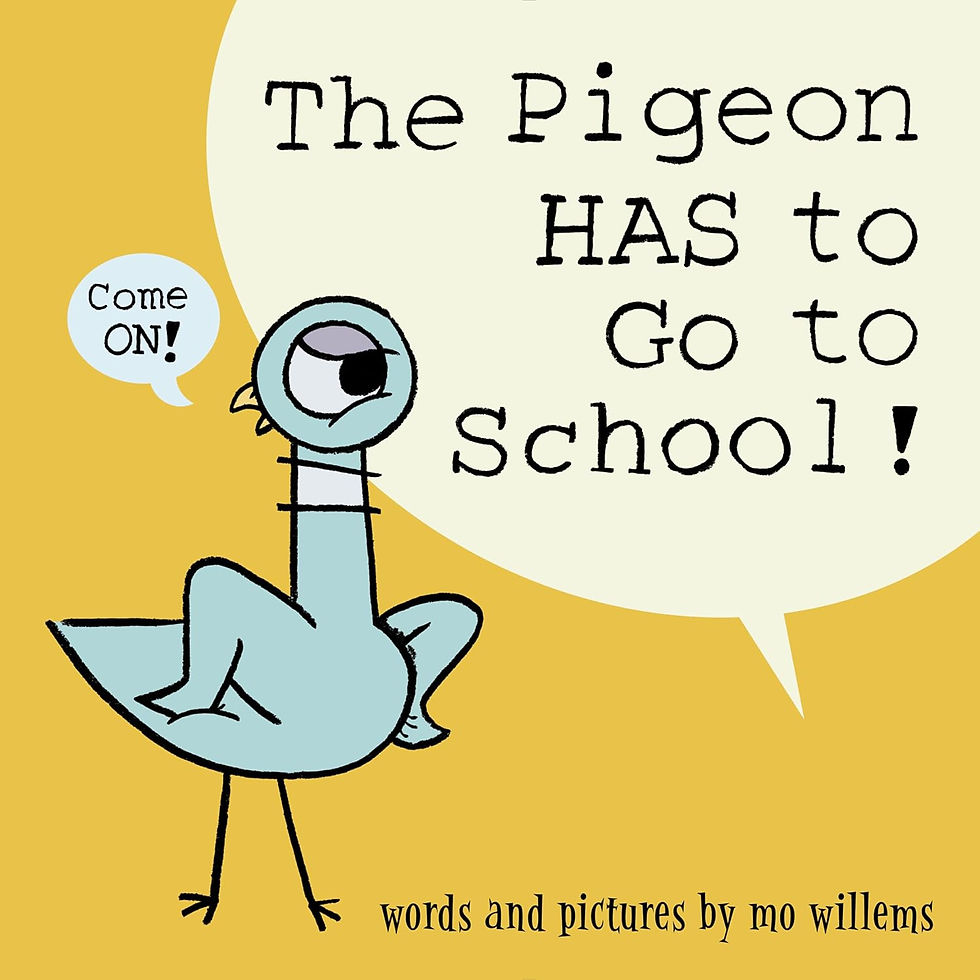
3s Lesson Plan - The Pigeon HAS to Go to School!
Materials:
The Pigeon HAS to Go to School! by Mo Willems
Sentence strip or cardstock name cards for each child (first letter uppercase, the rest lowercase)
Magnetic letters, foam letters, or letter tiles (optional)
Backpack labeled “Pigeon’s Backpack”
Lesson Steps
Welcome & Warm-Up
Pass out the name cards and invite the children to the carpet.
Greet each child at the carpet by saying: “Good morning, [Name]! Are you ready for school today?”
Invite children to say, "Yes! Good morning!" and place their name cards in “Pigeon’s Backpack” as they arrive at the carpet.
Book Introduction
Show the cover and title of The Pigeon HAS to Go to School!
Ask:
“What do you think is going to happen in this story?”
“How do you think Pigeon feels about going to school?”
Read-Aloud
Read with expression, especially exaggerating Pigeon’s dramatic moments.
Pause to talk about Pigeon’s feelings:
“Pigeon says, ‘I already know everything!’ Do you think that’s true?”
“How can you tell Pigeon feels nervous/excited?”
Encourage children to join in on repeated phrases or sound effects.
Song: This is the Way We Go to School by Kiboomers
Name Activity - Pigeon’s Name Parade
One by one pull a name card out of Pigeon’s Backpack.
Hold up a card: “Pigeon wants to know… is [Name] ready for the parade?”
When the child’s name is called:
The child flaps their wings like Pigeon and marches in a circle with their card.
Once they return, they hold up their card and point to the first letter of their name.
If ready, they can say: “My name starts with [letter]!”
Place the card in a pocket chart or wall display called “Pigeon’s Class Parade.”
Closing
Review: “Today, we learned that Pigeon was nervous about school, but he came anyway—just like all of you did!”
Sing a song with each child’s name. Hold up their name and encourage them to stand when they hear it: "[Name] came to school today, We learned and laughed and got to play!"
Extensions
Art: Pigeon & Me Bus Mural – On a big piece of butcher paper, draw a large school bus outline. Each child creates a small self-portrait (or simply their name) to paste into a bus window alongside a picture of Pigeon.
Blocks: Build a “school” out of blocks for Pigeon to go into. Add in figurines.
Dramatic Play: Add a “Pigeon Goes to School” prop box with backpacks, books, and a plush Pigeon.
Additional Book Recommendations for 3s:
Maisy Goes to Preschool by Lucy Cousins
Pete the Cat: Rocking in My School Shoes by James Dean & Eric Litwin
Mixed: A Colorful Story by Arree Chung
Watch an explanation of the lessons here:
4s Lesson Plan - Froggy Goes to School

Materials
Froggy Goes to School by Jonathan London
Fly cutouts with names written on them
Frog puppet or plush toy (optional, for extra engagement)
Lily pad cutouts (green cardstock or foam shapes) – one per child with their name written on it
Blue cloth or paper for pond
Lesson Steps
Welcome & Warm-Up
Greet children at circle time and hand them the fly with their name on it.
Say: “Today, Froggy is coming to school too! He is hungry! Let's feed him flies!"
Call out a child's name in the frog's voice. That child comes to the front to "feed" the fly with his/her name on it.
Book Introduction
Show the cover and say: “This is Froggy. He’s feeling a little nervous about school—just like some of us might be.”
Ask: “What do you think will happen on Froggy’s first day?”
Read-Aloud
Read with lots of expression, especially for Froggy’s silly sound effects (“flop flop flop,” “zoop,” “zip”).
Pause and ask:
“Have you ever felt nervous like Froggy?”
“What helps you feel better at school?"
Encourage children to join in on Froggy’s repeated sounds and actions.
Song: Jump Like a Frog by Kiboomers
Name Activity – “Find Your Lily Pad”
Scatter all the name lily pads around the room.
Have “Froggy” (you or a puppet) say: “It’s time to hop to school! Can you find YOUR lily pad?”
Call one child at a time by name.
They hop like a frog to their lily pad.
Once they find it, they say their name aloud and place it in a “Pond” area (a blue blanket or circle on the floor).
Continue until all children have found their lily pads.
Closing
Gather the lily pads in a pocket chart or display as a “Froggy’s Class” visual.
Say: “Froggy was nervous, but he came to school and had a great day—just like all of you!”
End with a goodbye chant: “[Name] did great today! Can you jump like a frog and shout hooray?”
Extensions
Art Center: Decorate their lily pad with stickers or markers.
Dramatic Play: Add backpacks, lunchboxes, and pretend school items for a “Froggy’s First Day” role-play area.
Reading: Create lily pads with names on one and pictures on others. Encourage the children to match the lily pads.
Additional Book Recommendations for 4s:
If You Ever Want to Bring an Alligator to School, Don’t! by Elise Parsleyy.
Chrysanthemum by Marc Brown
Our Class is a Family by Shannon Olsen
Watch an explanation of the lesson below!
Share these ideas with your staff and teammates!
Grab the PDF version below!
In Conclusion...
The first days of school set the tone for everything that follows, and names are the perfect bridge between home, heart, and learning. Whether you’re greeting 2s with Rosie, marching with Pigeon and the 3s, or hopping along with Froggy and the 4s, name-centered lessons spark joy, connection, and confidence from day one.
I’d love to hear how you use names in your classroom to build community and literacy! Drop a comment below with your favorite activity, book, or tip. You just might inspire another teacher as we all start this new school year together.
Don't miss an update from Moving Little Minds! SUBSCRIBE HERE!

We believe that every child deserves a bright future, and this begins with a strong foundation in early literacy skills. At Moving Little Minds, we are dedicated to providing research-based literacy activities in fun and engaging ways! By merging instruction with play, we ensure that children are reaching their full potential and embark on their educational journey well-prepared for the
future! Let's build those KEY emergent literacy skills together.


%20(52).jpg)

Comments