
Fine Motor Skills: Why Handwriting Instruction Should Not Drive Alphabet Instruction


What children can do with their fine motor skills does not match what they can do with their minds...
I will never forget the first time this question came up during a preschool training:
“We use Handwriting Without Tears. How can we possibly switch to letter cycles and make it all work?”
It is a valid question. On the surface, it makes sense. Of course we want alignment. If children are learning letters, shouldn’t letter formation match that instruction?
But then it really set in.
Handwriting is a skill. And like all fine motor skills, it develops on its own timeline. Alphabetic knowledge is different. It is cognitive. It can grow much faster than a child’s ability to physically form letters.
When we rely on handwriting pacing or a handwriting curriculum to dictate how we teach the alphabet, we unintentionally hold children back. We are asking their hands to lead…when their brains are ready to do so much more.
Today, we are going to shift that perspective.
We are going to look at why handwriting and alphabet instruction should not be treated as the same thing and how giving each the attention it deserves can completely change how children learn.
What Does Research Say About Handwriting and Fine Motor Skills?
At this point, I think we all know where I stand on alphabetic knowledge. It is an absolute must for learning to read and write.
But what about handwriting? Is it actually beneficial for young children?
The answer is yes!
Research shows that handwriting plays a meaningful role in how children learn and process letters:
Neuroscience research has found that handwriting increases brain activity and strengthens memory systems connected to learning.
A study using MRI scans of five-year-old children found that “reading circuits” in the brain are activated when children engage in handwriting, particularly in free-form writing rather than tracing (Karin Harman James & Laura Engelhardt, 2012).
This is where it gets really important. When children write letters in free form, without tracing, they are not just practicing a motor skill. They are actively retrieving letter knowledge.
They have to:
Recall the letter
Connect it to its sound
Produce it from memory
In other words, they are engaging the same systems used for reading.

This is why free-form handwriting practice is so valuable, and why we must make time for both direct instruction in letter formation and opportunities to write without visual supports. It is not just about forming letters neatly. It is about strengthening the brain’s ability to recognize, recall, and use letters.
When a child can hear a sound like /a/ and independently write the letter that represents it, that is a strong indicator that their alphabetic knowledge is truly established.
So now the real question…
If we cannot rely on handwriting to drive alphabet instruction, what do we do instead?
What This Actually Looks Like in the Classroom
If both alphabet knowledge and handwriting matter, but develop differently, our instruction has to reflect that.
Children can learn letter names and sounds long before they are able to physically write those letters. We see this every day in classrooms. A child may confidently identify a letter and produce its sound yet struggle to form it.
That is not something to fix. That is development. Research points us toward separating the developmental pathways while still allowing the skills to support one another.
This means introducing letters in ways that do not rely on pencil-and-paper tasks, which is exactly how we teach in our Moving Little Minds curriculums.
Children can:
Trace letters with their fingers
Form letters in the air
Build letters using materials
Sort and compare letter features (lines, curves, orientation)
Identify similarities and differences across letters
These practices support visual recognition, memory, and discrimination, all critical components of alphabet knowledge and of handwriting.
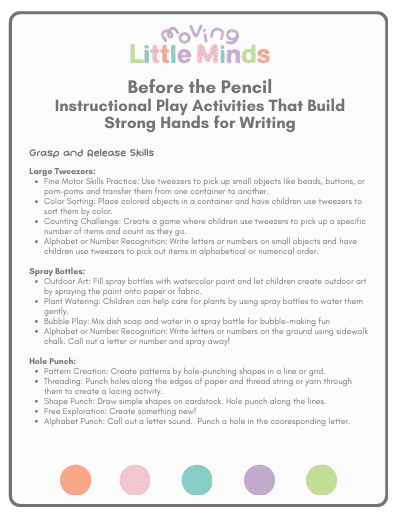
At the same time, fine motor development, which ultimately leads to pencil and paper handwriting, can be supported through broader experiences:
Manipulative play
Hand strengthening activities
Pre-writing movements and patterns
This allows handwriting readiness to develop without limiting access to alphabet learning.
Fine Motor Development Activities
Be sure to download this simple guide to begin building strong hands and minds! Share with a teacher friend, too!
Bringing the Two Together
As children develop the motor control needed for writing, handwriting can be layered into instruction in a way that does not slow down alphabet learning.
This is where letter cycles make a meaningful difference.

Because children are exposed to all letters regularly through a research-based cycle with built-in review, handwriting no longer has to act as the driver of alphabet instruction. The pressure is removed.
Instead, we can focus on building strong alphabet knowledge first, while intentionally layering in handwriting as children are developmentally ready.
When using letter cycles, there are two simple approaches:
Separate instructional blocksHandwriting is taught explicitly as a motor skill at a different time. Because children are consistently exposed to all letters through the cycle, it does not need to “match” the letter of the day for learning to occur.
Pair handwriting within the cycleHandwriting is layered into the cycle in a way that maintains repeated exposure:
In Letter Cycle 2 (one letter per day), focus on sky writing for both uppercase and lowercase, and introduce pencil and paper practice of the uppercase letter.
In Letter Cycle 3 (two letters per week), students practice both uppercase and lowercase using pencil and paper.
Both approaches maintain the integrity of alphabet instruction while still providing intentional, explicit handwriting practice.
If you do not have our letter cycle framework, grab it HERE.
Final Takeaways
The research is clear on three points:
Alphabet knowledge is a critical predictor of reading success
Handwriting supports learning but develops along a different timeline
These skills must be developed intentionally, but not paced the same way
Children can know letters before they can write them. And when we allow their understanding to grow without being limited by motor development, we create stronger, more confident learners.
When we separate how these skills develop, but intentionally connect how they are taught, we create stronger outcomes for children. Let's continue to do what is best for our children!
Don't miss an update from Moving Little Minds! SUBSCRIBE HERE!

We believe that every child deserves a bright future, and this begins with a strong foundation in early literacy skills. At Moving Little Minds, we are dedicated to providing research-based literacy activities in fun and engaging ways! By merging instruction with play, we ensure that children are reaching their full potential and embark on the educational journey well-prepared for the future! Let's build those KEY emergent literacy skills together.


%20(52).jpg)

Comments