
Are We Overcomplicating Phonological Awareness in Pre-K Classrooms?


I Might Ruffle a Few Feathers with This...
I’m going to get a little real in this week’s newsletter… and it might ruffle a few feathers.
Lately, I’ve been thinking a lot about phonological awareness and what it really looks like in preschool.
It actually all started with an article I came across titled Educators Were Sold a Story About Phonemic Awareness by Curriculum Insights Project and Karen Vaites—an article that takes a closer look at the rise of structured phonemic awareness programs like Heggerty.
Now, I know many preschool teachers use the scripted program Heggerty, and many truly love it. It’s structured and easy to use, and it feels like you’re doing something “right.”
But after reflecting on the research in this article, as well as what I have experienced teaching, I’ve found myself wondering…
Is something that structured, and honestly, a bit drill-focused, actually necessary to teaching phonological awareness in pre-k?
Because in my classroom, yes, we use short, explicit instruction. Yes, we introduce skills with quick routines and simple hand motions. But the real growth happens in the play. In the songs, the stories, the movement, the games. It happens when children are actively engaged, not just responding.
And here’s the best part…the play-based approach is working! I see it in the classroom, and I hear it from both teachers and caregivers. Children are catching on!
So, when I read that article that found the too much of a good thing, may not be a good thing, it made me pause even more.
If that’s true, then it’s worth taking a closer look at what we’re doing in preschool, and more importantly, why we’re doing it.

Our children need intentional instruction that is meaningful, engaging, and built into the way they naturally learn. They need opportunities to hear, play with, and explore sounds in ways that feel active and connected.
And when we get that balance right, when we combine explicit instruction with play, we don’t just check a box. We build skills that actually stick!
What the Research Actually Says About Phonemic Awareness
Now, let’s get clear on something. First. I am a huge proponent of short amounts of explicit instruction.
Phonological awareness is not a skill children simply pick up through play alone. It requires intentional modeling, repetition, and practice.
We know this. We also know that research consistently shows that:
✔ Phonological awareness instruction benefits all children
✔ Children with economic disadvantages especially benefit from explicit, intentional instruction
✔ Strong phonological awareness, particularly phonemic awareness (identifying individual sounds in words) is a critical predictor of later reading success

So, this is not about removing instruction. But it does raise an important question about what does the research actually say about delivery of instruction?
Is a highly structured, drill-based program necessary in preschool? Or are we overcomplicating something that could be much simpler?
Here’s where it gets really interesting. The research referenced in the article suggests that phonemic awareness does not require long, isolated blocks of instruction to be effective.
In fact, the article sites that a 2024 metanalysis found that, “PA instruction effects improved with increasing dosage up to 10.20 hours of instruction (dmax = 0.74), after which the effects declined," (Erbeli et al., 2024).
In simple terms, more is not always better. More time does not automatically lead to better outcomes, especially when phonemic awareness is taught in isolation rather than connected to meaningful learning, particularly alongside of phonics and spelling.
So when we think about this in real preschool classroom terms, it shifts the conversation.
If a child attends a typical half-day preschool program—about 180 days per year, that amount of focused instruction, when spread across the year, is surprisingly small...less than five minutes if we were doing simple math!
Which leads us to a much more practical question…
What Can We Do with Five Intentional Minutes of Phonological Awareness in Pre-K Classrooms?

When we look at phonological awareness from this lens, everything begins to shift. We don't necessarily need more time; we need more intention.
When we make learning playful, it sticks! If you are ready to add a little more play to your phonological awareness instruction, here are playful, hands-on ways to build skills in just a few minutes a day!
Ages 2-3
1. Name Drum Game
Materials: Small drum or flipped bucket
What you do:
Tap the drum as you say each child’s name in parts.
“Ja-son” (tap-tap)
Let the child tap each name around the circle
Why it works:You’re building syllable awareness through movement and sound.
2. Banana Fana Name Game (Rhyme Play)
Materials: None
What you do:
Sing the Banana Fana song, using each child's name.
The child comes to the middle and jumps while the group sings. Sing a simple version using children’s names:
“Lily, Lily, bo-billy
Banana fana fo-filly
Fee-fi-mo-milly… Lily!”
Repeat with different names and let children join in.
Why it works: You’re exposing children to rhyme through repetition and play.
3. Sound Hunt
Materials: Familiar objects around the room, flashlights
What you do:
Say, “Let’s find something that starts with b-b-b…”
Children use flashlights to light up the object.
Why it works:Connects sounds to real objects through movement.
Ages 3-4

1. Feed the Puppet (Blending Game)
Materials: Puppet + picture cards or small objects
What you do:
The puppet “talks slowly.”
“I want a b…a…t…”
Children guess and feed the puppet the correct item.
Why it works: Builds blending in a highly engaging way.
2. Syllable Hop
Materials: Floor spots or paper squares
What you do:
Say a word and children jump once for each part
“ap-ple” → 2 jumps
Choose a category, names, snacks, etc.
Why it works: Links body movement to breaking words apart.
3. Rhyme Basket Surprise
Materials: Basket with small objects (cat, hat, ball, doll)
What you do:
Pull out two objects and say their names.
“cat… hat… do these rhyme?”
Children stand and say "That rhymes, that rhymes" while wiggling legs or shake finger and say "No way, no way"
You can extend by asking, “Can you think of another word that rhymes?”
Why it works: You’re building rhyme recognition and beginning to encourage children to generate rhymes in a playful way.
Ages 4-5
1. Sound Box Push

Materials: Sound boxes (grab HERE) and blocks or pom-poms
What you do:
Say a word. Children push one pom-pom per sound.
“dog” → /d/ /o/ /g/
Begin with two sounds and work your way to three
Why it works: Builds phoneme segmentation in a concrete way.
2. Mystery Bag Sound Game
Materials: Bag with small objects
What you do:
Give a sound clue.
“I have something that starts with /b/ and it rhymes with cat..."
Children pull and check.
Why it works: Strengthens beginning sound awareness and rhyme through critical thinking
3. Switch the Sound Hop
Materials: Three squares on the floor
What you do:
Place 3 spots on the floor for each child.
Say a word: “cat”
Children hop once for each sound said aloud:
/c/ (hop) /a/ (hop) /t/ (hop)
Then say: “Now change /c/ to /m/…”
Children hop again and say “mat.”
Why it works: You’re connecting movement to each sound, helping children break apart and change sounds in words.
A Planning Tool for You
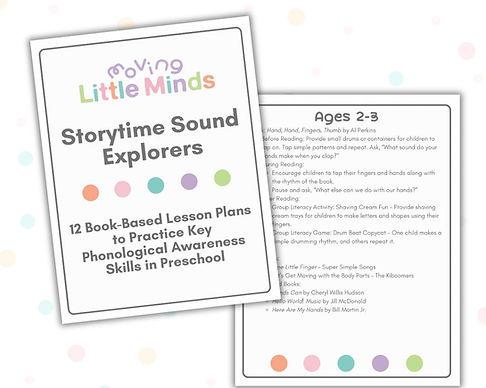
Be sure to share this simple guide to begin fun and intentional phonological awareness play at your school!

Final Thoughts
At the end of the day, this isn’t about choosing between instruction or play.
It’s about understanding how to bring the two together in a way that actually works for young children.
We can absolutely teach these critical early literacy skills with intention and clarity. At the same time, we can create learning experiences that feel engaging, active, and meaningful, because that’s how children learn best.
I would truly love to hear your thoughts on this. Drop a comment below!
Visit Our Shop to Continue Supporting Phonological Awareness through PLAY!!

Whether you are just getting started with phonological awareness and want more information with our course, or you are ready to follow a simple curriculum that tells you exactly what to teach, we are here for you!
Check out our products below!
Don't miss an update from Moving Little Minds! SUBSCRIBE HERE!

We believe that every child deserves a bright future, and this begins with a strong foundation in early literacy skills. At Moving Little Minds, we are dedicated to providing research-based literacy activities in fun and engaging ways! By merging instruction with play, we ensure that children are reaching their full potential and embark on the educational journey well-prepared for the future! Let's build those KEY emergent literacy skills together.


%20(52).jpg)

Comments